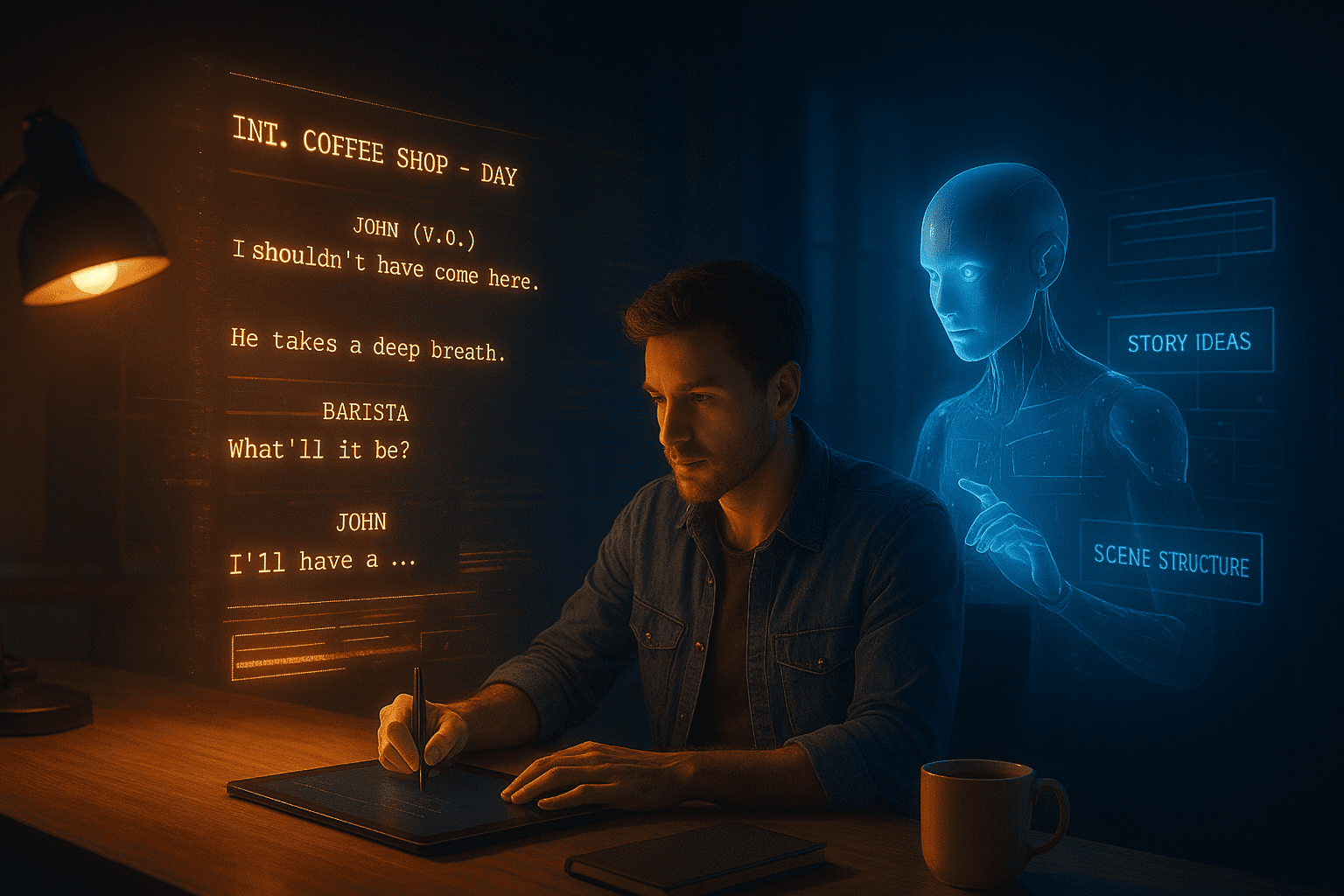
Introduction: The New Era of AI-Powered Scriptwriting
Scriptwriting using AI has fundamentally transformed how creators, marketers, and filmmakers approach content creation. What once required hours of staring at blank pages, multiple drafts, and endless revisions can now be accomplished in a fraction of the time with artificial intelligence as your collaborative writing partner.
The resistance many writers initially felt toward AI has evolved into pragmatic adoption. AI isn’t replacing the craft of storytelling—it’s eliminating writer’s block, accelerating the ideation process, and handling structural heavy lifting so writers can focus on what truly matters: authentic voice, emotional resonance, and compelling narratives that connect with audiences.
This comprehensive guide explores the best AI scriptwriting tools available in 2025, proven techniques for getting optimal results, common pitfalls to avoid, and real-world workflows that professional scriptwriters are using to produce higher-quality content more efficiently. Whether you’re writing YouTube videos, short films, marketing content, or feature-length screenplays, these strategies will elevate your scriptwriting process.
Understanding AI Scriptwriting Technology
How AI Scriptwriting Actually Works
Modern AI scriptwriting tools use large language models (LLMs) trained on massive datasets of existing scripts, screenplays, novels, and dialogue. These models understand narrative structure, character development, pacing, and genre conventions at a sophisticated level.
The process typically involves:
- Input: You provide a premise, character details, tone, or specific scenes
- Processing: AI analyzes patterns from millions of successful scripts
- Generation: The system creates original content matching your specifications
- Iteration: You refine through conversation, making the output progressively better
The key advantage? AI can instantly generate multiple variations, explore different narrative directions, and suggest dialogue options that you might not have considered—all while maintaining structural coherence.
What AI Can and Cannot Do for Scriptwriters
AI excels at:
- Breaking through writer’s block with instant first drafts
- Generating multiple scene variations for comparison
- Maintaining consistency in character voice across long scripts
- Formatting scripts to industry standards
- Creating outlines and beat sheets rapidly
- Suggesting dialogue alternatives and punch-up options
- Researching and incorporating factual details
AI struggles with:
- Creating truly original, groundbreaking concepts
- Understanding subtle cultural nuances and current references
- Capturing deeply personal, authentic human experiences
- Making bold creative risks that define great art
- Understanding your specific brand voice without extensive training
- Navigating complex emotional subtext
The winning formula: Use AI as a collaborative brainstorming partner and structural assistant, but inject your unique perspective, emotional intelligence, and creative vision into every script.
Top AI Scriptwriting Tools for 2025
1. ChatGPT: The Versatile Scriptwriting Assistant
Official Website: https://openai.com/chatgpt
ChatGPT has become the go-to AI writing tool for millions of creators due to its conversational interface, flexibility, and constantly improving capabilities. For scriptwriting specifically, ChatGPT excels at dialogue generation, scene development, and iterative refinement.
Key scriptwriting capabilities:
- Character development: Create detailed character profiles with backstories, motivations, and voice
- Scene writing: Generate individual scenes with specific emotional beats
- Dialogue polish: Refine conversations to sound more natural
- Structure assistance: Outline three-act structures, hero’s journey frameworks
- Format adaptation: Convert prose into proper script format
- Research support: Provide historical context, technical details
Pricing:
- Free tier: GPT-3.5 with limitations
- Plus: $20/month (GPT-4 access, faster responses)
- Team: $30/user/month
- Enterprise: Custom pricing
Best for: Individual writers, YouTube creators, marketers, and anyone needing flexible AI assistance across multiple script types.
Pro workflow example: A YouTube creator uses ChatGPT to generate three different script openings for each video, tests them with audience polls, then uses the winner as their foundation while adding personal stories and unique perspectives.
✅ Pros
- Conversational refinement through follow-up questions
- Excellent at understanding context across long conversations
- Handles multiple script formats and genres
- Constantly updated with improvements
❌ Cons
- Free version has significant limitations
- Can be verbose without specific guidance
- Requires clear prompts for best results
- No built-in script formatting tools
2. Claude: Advanced Reasoning for Complex Scripts
Official Website: https://claude.ai
Claude (created by Anthropic) distinguishes itself with superior reasoning abilities, nuanced understanding of character development, and exceptional performance on longer-form scripts where maintaining consistency matters.
Standout features:
- Longer context window: Handle entire feature-length screenplays in one conversation
- Character consistency: Maintains voice and personality across 100+ pages
- Nuanced dialogue: Captures subtle emotional undertones effectively
- Structural analysis: Identifies pacing issues and plot holes
- Collaborative editing: Responds well to “make this more intense” or “add humor here” requests
Pricing:
- Free tier: Limited daily usage
- Pro: $20/month (5x more usage, priority access)
Best for: Screenwriters working on feature films, TV pilots, or any long-form narrative requiring sophisticated character work.
Real application: A television writer used Claude to develop a 60-page pilot script, iteratively refining character arcs and ensuring subplot consistency. The AI helped identify three major plot holes during the outline phase, saving weeks of rewrites.
✅ Pros
- Exceptional with complex, multi-layered narratives
- Better at understanding emotional subtext
- Thoughtful, less formulaic responses
- Great for developmental conversations
❌ Cons
- Free tier more limited than ChatGPT
- Slightly slower response times
- Less widely adopted (fewer tutorials available)
- May be overly cautious with controversial content
3. Jasper AI: Marketing-Focused Script Creation
Official Website: https://www.jasper.ai
Jasper AI specifically targets marketing professionals, with templates and workflows designed for commercial video scripts, social media content, and advertising copy.
Marketing script features:
- Video script templates: Pre-built structures for ads, explainers, testimonials
- Tone customization: Match brand voice guidelines precisely
- Boss Mode: Command-based writing for rapid script generation
- Plagiarism checker: Ensure originality for commercial use
- Team collaboration: Share brand voice across multiple writers
- Integration capabilities: Connect with other marketing tools
Pricing:
- Creator: $49/month (1 user, 50 brand voices)
- Teams: $125/month (3 users, 150 brand voices)
- Business: Custom pricing
Best for: Marketing agencies, brand managers, social media teams, and businesses creating commercial video content.
Business case: An advertising agency cut script development time by 70% using Jasper’s templates for client video ads. They generate 5-10 variations per concept, test with focus groups, and refine the top performers—a workflow impossible with manual writing.
✅ Pros
- Purpose-built for commercial content
- Excellent brand voice consistency
- Fast generation with templates
- Team features for agencies
❌ Cons
- Expensive compared to general AI tools
- Less suitable for creative/artistic scripts
- Marketing-focused features may not suit all needs
- Requires subscription (no free tier)
4. Sudowrite: AI for Creative Writers
Official Website: https://www.sudowrite.com
Sudowrite targets novelists and creative writers but works beautifully for dialogue-heavy scripts, character development, and narrative storytelling.
Creative writing strengths:
- Story Engine: Develop plots from concept to outline
- Character builder: Deep personality profiles with voice samples
- Rewrite function: Transform scenes with different emotional tones
- Brainstorm: Generate creative alternatives for any element
- Describe: Add sensory details and atmosphere
- Tone analysis: Ensure emotional consistency
Pricing:
- Hobby & Student: $19/month (225,000 AI words)
- Professional: $29/month (1,000,000 words)
- Max: $129/month (2,000,000 words)
Best for: Screenwriters, playwrights, and anyone writing character-driven narratives with rich dialogue and emotional depth.
Testimonial insight: Multiple screenwriters report that Sudowrite’s “Show, Don’t Tell” feature helps transform expository dialogue into visual storytelling—a critical skill for screen writing that even experienced writers struggle with.
✅ Pros
- Designed specifically for creative storytelling
- Excellent character voice consistency
- Multiple creative tools in one platform
- Understands show-don’t-tell principles
❌ Cons
- Word limits can feel restrictive
- Higher price point for max usage
- Learning curve for all features
- Less effective for non-narrative scripts
5. Writesonic: Budget-Friendly Script Generator
Official Website: https://writesonic.com
Writesonic offers AI scriptwriting capabilities at more accessible price points, making it ideal for creators and small businesses watching budgets carefully.
Affordable features:
- Video script generator: Quick social media and YouTube scripts
- Article to video: Transform blog posts into video scripts
- Multiple languages: 25+ language support
- SEO optimization: Scripts optimized for discoverability
- Chrome extension: Write anywhere on the web
Pricing:
- Free trial: 10,000 words/month
- Individual: $16/month
- Standard: $33/month
- Professional: $83/month
Best for: Budget-conscious creators, small businesses, educators, and anyone producing high-volume short-form scripts.
✅ Pros
- Very affordable entry point
- Fast generation speeds
- Good for social media scripts
- User-friendly interface
❌ Cons
- Less sophisticated than premium tools
- Better for short-form than long-form
- Limited creative depth
- Output can feel templated
6. Final Draft with AI Features
Official Website: https://www.finaldraft.com
Final Draft remains the industry-standard screenwriting software, now enhanced with AI-powered beat suggestions, character analysis, and formatting assistance.
Professional screenwriting tools:
- Beat Board: Visualize story structure with AI suggestions
- AI-powered outlining: Generate scene sequences from loglines
- Character Navigator: Track all character appearances and arcs
- Industry-standard formatting: Automatic screenplay format
- Collaboration tools: Real-time co-writing capabilities
Pricing:
- One-time purchase: $299.99
- Subscription: $14.99/month
Best for: Professional screenwriters submitting to studios, production companies, and film festivals where industry-standard formatting is non-negotiable.
Industry perspective: While Final Draft’s AI features aren’t as advanced as dedicated AI writing tools, the seamless integration with professional formatting and industry acceptance makes it the preferred choice for serious screenwriters who can use ChatGPT or Claude for generation, then refine in Final Draft.
✅ Pros
- Industry-standard formatting
- Professional credibility
- One-time purchase option
- Comprehensive scriptwriting tools
❌ Cons
- Expensive upfront cost
- AI features less advanced than pure AI tools
- Steep learning curve for beginners
- Desktop-only (limited mobile options)
Proven AI Scriptwriting Techniques
The Iterative Prompt Method
The most effective AI scriptwriting isn’t one prompt and done—it’s a conversation that progressively refines output.
Successful workflow:
- Broad concept prompt: “Write a 3-minute video script about overcoming procrastination for entrepreneurs”
- Review output, identify gaps: AI might miss your target audience’s specific pain points
- Refine with specifics: “Rewrite focusing on perfectionism as the root cause, speaking to creative professionals”
- Add personality: “Make the tone more conversational, add a personal story about missing a deadline”
- Polish specific sections: “Make the opening hook more urgent and compelling”
Each iteration improves quality significantly. Plan for 3-5 refinement rounds rather than expecting perfection immediately.
Character Voice Development
AI struggles with consistent character voice without clear direction. Build comprehensive character profiles first:
Effective character prompts include:
- Demographics: Age, background, education, profession
- Personality traits: Three dominant characteristics with examples
- Speech patterns: Vocabulary level, sentence structure, catchphrases
- Motivations: What drives them, what they fear
- Sample dialogue: 3-4 lines showing their voice
Example: “Sarah is a 32-year-old data scientist. She speaks precisely, uses technical metaphors in everyday conversation, and gets frustrated when people make decisions based on feelings rather than evidence. Sample line: ‘I ran the numbers three times. The correlation is clear, even if it feels counterintuitive.'”
This level of detail helps AI maintain voice consistency across your entire script.
Structural Templates for Better Results
AI performs better with clear structural frameworks. Provide templates:
Video script structure:
- Hook (0-8 seconds): Compelling opening question or statement
- Problem (8-30 seconds): Establish the challenge viewers face
- Solution introduction (30-45 seconds): Preview what you’ll teach
- Main content (45 seconds – 3 minutes): 3-5 key points with examples
- Recap and CTA (final 20 seconds): Summarize and direct action
Screenplay structure:
- Act 1 (pages 1-30): Setup, inciting incident, first plot point
- Act 2A (pages 30-60): Rising action, midpoint
- Act 2B (pages 60-90): Complications, all seems lost
- Act 3 (pages 90-120): Climax, resolution
Provide these frameworks explicitly in your prompts for coherent, well-paced scripts.
The “Show, Don’t Tell” Technique
AI defaults to expository dialogue. Train it to show rather than tell:
Weak AI output:
“I’m really angry right now because you betrayed me.”
Improved prompt: “Instead of having the character say they’re angry, show their anger through physical actions and subtext.”
Better AI output:
“She slammed the coffee cup on the counter, dark liquid splashing across the white tile. ‘Interesting choice.’ Her voice was steady, but her hands trembled as she gripped the edge of the sink.”
Always follow up weak exposition with prompts that demand visual storytelling.
Advanced AI Scriptwriting Workflows
The Hybrid Approach: Human + AI Collaboration
Professional scriptwriters use a layered workflow:
Phase 1 – Ideation (AI-heavy):
- Brainstorm 20 concepts with AI
- Generate multiple loglines
- Develop character profiles
- Outline story beats
Phase 2 – Structure (Collaborative):
- AI generates detailed outline
- Human reorganizes for optimal pacing
- Identify emotional high/low points together
- Plot hole analysis with AI assistance
Phase 3 – First Draft (AI-assisted):
- AI writes scene drafts
- Human adds unique voice and personal touches
- Focus AI on dialogue, human on action/description
- Alternate sections between AI and human writing
Phase 4 – Refinement (Human-heavy):
- Human rewrites for authenticity
- AI suggests punch-up options for weak moments
- Polish dialogue for naturalism
- Final pass entirely human
This workflow balances efficiency with authenticity.
Multi-Tool Integration Strategy
Don’t limit yourself to one AI tool. Professional writers stack capabilities:
Content strategy stack:
- ChatGPT: Initial concept development and research
- Claude: Detailed character development and dialogue
- Sudowrite: Creative alternatives and emotional depth
- Final Draft: Professional formatting and final polish
- Grammarly: Copy editing and clarity checks
Each tool’s strengths complement the others, creating a comprehensive workflow that outperforms any single solution.
Testing and Iteration Framework
Professional scriptwriters test AI output rigorously:
- Generate 3-5 variations of key scenes
- Read aloud to catch unnatural dialogue
- Test with target audience if possible
- Analyze pacing (does it drag or rush?)
- Character consistency check across all scenes
- Emotional beat tracking (proper rhythm?)
- Revise weak sections with targeted prompts
Treat AI output as a first draft, never final copy. The testing phase separates amateur from professional AI-assisted writing.
Common Scriptwriting Mistakes with AI
Over-Reliance on First Output
The trap: Using whatever AI generates first without refinement or personal input.
Why it fails: First-draft AI writing is generic, lacks authentic voice, and misses emotional nuance that connects with audiences.
The solution: Always plan for 3-5 iterative refinements. Add personal experiences, unique perspectives, and authentic voice elements that AI cannot generate.
Ignoring Format Requirements
The mistake: Assuming AI automatically formats scripts correctly for your specific medium.
The reality: YouTube scripts, screenplays, stage plays, and commercial spots each have different formatting conventions.
The fix: Explicitly specify format in your prompts: “Write this as a two-column A/V script for a corporate video” or “Format this as a proper film screenplay with sluglines and action description.”
Neglecting Voice and Tone Consistency
The problem: Not providing clear voice guidelines, resulting in inconsistent tone throughout the script.
Example: A script that starts casual and conversational, shifts to formal in the middle, then becomes overly comedic at the end—confusing and unprofessional.
Professional approach: Create a “voice guide” document defining your tone (conversational, authoritative, humorous, inspirational), vocabulary level, sentence structure preferences, and examples. Reference this in every AI interaction.
Accepting Generic Dialogue
Red flag: If characters sound interchangeable, your AI dialogue needs work.
Test: Cover character names and see if you can identify who’s speaking. If not, the dialogue is too generic.
Improvement technique: Give each character a unique speech pattern, vocabulary quirk, or conversational style. Tell AI: “Character A speaks in short, declarative sentences. Character B uses elaborate metaphors and never gives direct answers.”
Industry-Specific AI Scriptwriting Applications
YouTube and Video Content Scripts
YouTube scriptwriting has unique requirements that AI handles exceptionally well:
Essential elements:
- Hook within 5 seconds: AI can generate multiple attention-grabbing openings
- Pattern interrupts: Keep viewers engaged every 30-60 seconds
- SEO keyword integration: Natural placement without awkwardness
- Clear structure: Introduction, main content, recap, call-to-action
- Conversational tone: Sounds natural when read aloud
Optimal prompt: “Write a 1,200-word YouTube script for [topic], targeting [audience]. Include a hook in the first 5 seconds, address [pain point], provide [number] actionable tips, and end with a strong call-to-action to subscribe. Conversational tone as if talking to a friend.”
Marketing and Commercial Scripts
Commercial scripts demand precision and persuasion:
Key components:
- Value proposition clearly stated in opening 10 seconds
- Emotional connection to customer pain points
- Social proof or credibility indicators
- Clear call-to-action with urgency or benefit
- Brand voice consistency across all assets
AI advantage: Generate multiple variations testing different emotional appeals (fear, aspiration, belonging, logic), then A/B test to find highest-converting approach.
Film and Television Scripts
Long-form screenwriting requires sophisticated AI use:
Professional workflow:
- Logline development: AI generates 20+ options, you select strongest
- Beat sheet creation: Outline major plot points with AI assistance
- Scene-by-scene development: Alternate between AI drafts and human refinement
- Dialogue polish: Use AI for alternative line readings
- Script notes incorporation: AI helps execute feedback from producers
Reality check: AI-generated screenplays still require substantial human editing to reach professional submission quality. Use AI to accelerate development, not replace craft.
Ethical Considerations in AI Scriptwriting
Disclosure and Authenticity
The debate: Should creators disclose AI assistance in scriptwriting?
Professional consensus: Disclosure depends on the level of AI involvement and context:
- AI-assisted (human-led): Generally no disclosure needed—like using spell check or grammar tools
- Significantly AI-generated: Consider disclosure, especially for creative work
- Commercial content: Client deserves to know workflow
- Academic or credited work: Disclosure typically required
My perspective: Audiences care about quality and authenticity more than tools used. Focus on creating genuine value. However, building trust through transparency often outweighs short-term concerns about perception.
Copyright and Ownership
Current legal landscape (subject to change):
- AI-generated content: Copyright protection is unclear and evolving
- AI-assisted content: Human creativity receives standard copyright protection
- Best practice: Substantially edit and personalize all AI output
Recommendation: Treat AI as a collaborative tool where you maintain creative control and authorship. Don’t simply publish unedited AI output.
Maintaining Creative Integrity
The philosophical question: Does AI assistance diminish artistic merit?
Historical context: Every new tool—from typewriters to word processors to spell check—faced similar criticism. The medium changes; creativity endures.
The standard: Judge scripts by their final quality, emotional impact, and audience connection—not the tools used in creation. AI that helps you tell better stories faster enhances rather than diminishes your creative work.
Future of AI Scriptwriting Technology
Emerging Capabilities
What’s coming in the next 1-2 years:
- Real-time collaboration: AI that functions as a co-writer in live brainstorming sessions
- Voice-to-script: Speak your ideas naturally, AI structures them into properly formatted scripts
- Emotional intelligence: AI that better understands and generates subtle emotional nuance
- Visual integration: AI that writes scripts while suggesting corresponding visuals simultaneously
- Personalized learning: AI that studies your writing style and mimics it authentically
Multimodal scriptwriting will combine text, voice, images, and video references seamlessly.
Preparing for AI-Native Scriptwriting
Skills that will matter more:
- Creative direction: Knowing what you want before AI generates it
- Prompt engineering: Communicating effectively with AI systems
- Story sense: Recognizing what makes narratives compelling
- Audience understanding: Knowing what resonates with specific viewers
- Editing judgment: Identifying and fixing AI weaknesses
The writers who thrive will be those who view AI as a collaborative partner that amplifies rather than replaces their creative abilities.
Conclusion: Your AI Scriptwriting Journey
Scriptwriting using AI represents one of the most practical and immediately beneficial applications of artificial intelligence for creators across all industries. The tools and techniques covered in this guide provide a comprehensive foundation for integrating AI into your writing workflow while maintaining creative integrity and authentic voice.
Essential takeaways:
AI scriptwriting tools work best when used as collaborative partners rather than replacement writers. The most successful approach combines AI’s ability to generate options rapidly, maintain structural consistency, and overcome writer’s block with human creativity, emotional intelligence, and unique perspective that only you can provide.
Start with accessible tools like ChatGPT or Claude to develop your AI collaboration skills before investing in specialized platforms. Master the iterative refinement process—no AI output should be used without human review and personalization. Build character profiles, structural templates, and voice guidelines that help AI understand your specific needs.
The competitive advantage is clear: Scriptwriters using AI effectively are producing higher volumes of quality content, experimenting with more creative variations, and spending their mental energy on strategic storytelling decisions rather than struggling with blank pages.
Your next steps:
- Choose one AI tool from this guide and create a free account today
- Write your first AI-assisted script this week using the iterative prompt method
- Compare AI output with your manual writing—measure time savings and quality
- Develop your personal workflow combining AI efficiency with human creativity
- Refine continuously based on what works for your specific content type
The future of scriptwriting isn’t choosing between human or AI—it’s discovering how AI amplifies your unique creative voice. Your stories matter, your perspective is irreplaceable, and AI is simply the most powerful tool yet invented to help you share them with the world.
Ready to revolutionize your scriptwriting process? Open ChatGPT or Claude right now, try one technique from this guide on your next script, and experience the difference AI-assisted writing makes. Your most productive writing sessions are just one prompt away.
If this guide helped you, it might help others too — share it now on your favorite platform!
Continue Your Journey With:
AI Thumbnail Generation: Create Click-Worthy Images in Minutes
If you believe in spreading education and helping others grow, you can support my mission here:
Support Education, Empower Lives
Frequently Asked Questions (FAQs)
Do professional screenwriters actually use AI for scriptwriting?
Yes, an increasing number of professional screenwriters use AI tools, though most keep this detail private due to industry stigma and ongoing debates about creative authenticity. Industry surveys suggest 30-40% of working screenwriters experiment with AI tools for specific tasks like generating character backstories, brainstorming plot alternatives, overcoming writer’s block on difficult scenes, and rapid outlining during pitch development. However, professional writers emphasize they use AI as a development tool rather than a replacement for their craft—similar to how musicians use digital audio workstations but still consider themselves the creative artist. The Writers Guild of America has addressed AI usage in recent contract negotiations, establishing that AI-generated content cannot be considered “literary material” or source material, protecting writers’ credits and compensation. Most professionals view AI as a productivity enhancer that handles routine aspects of development, freeing mental energy for the creative decisions, emotional authenticity, and original voice that define great screenwriting. The stigma is gradually decreasing as the industry recognizes AI as another tool in the writer’s toolkit rather than a threat to the profession.
How do I make AI-generated scripts sound more natural and less robotic?
Making AI scripts sound natural requires intentional techniques during both generation and editing phases. First, always specify “conversational tone” in your prompts and request the AI write as if speaking to a friend rather than formal writing. Second, read all AI-generated dialogue aloud—your ear catches unnatural phrasing that looks fine on paper. Third, provide character-specific speech patterns like “Sarah speaks in short sentences and avoids technical jargon” or “Marcus uses pop culture references and never finishes his…” Fourth, use the iterative refinement method by asking AI to “rewrite this dialogue to sound more natural” or “make this less formal and more casual.” Fifth, add contractions, incomplete sentences, filler words (used sparingly), and realistic interruptions that mirror actual speech. Finally, the most critical step: personally edit every section, adding your own phrasing, cutting overly polished language, and injecting authentic human moments. The combination of specific prompting techniques and hands-on human editing transforms generic AI output into scripts that feel genuinely conversational and authentic.
What’s the best free AI tool for scriptwriting in 2025?
ChatGPT’s free tier stands out as the best no-cost option for scriptwriting, offering impressive capabilities including character development, scene generation, dialogue creation, and structural outlining without any financial investment. While the free version uses GPT-3.5 (less advanced than the paid GPT-4), it’s still remarkably capable for most scriptwriting needs including YouTube videos, short films, marketing scripts, and initial screenplay drafts. The conversational interface makes iterative refinement natural, and the model understands screenplay format, three-act structure, and genre conventions surprisingly well. Claude also offers a free tier with daily usage limits that some writers prefer for its nuanced understanding of character development and dialogue. For budget-conscious scriptwriters, starting with ChatGPT Free allows you to develop AI collaboration skills, understand what’s possible, and determine if upgrading to paid tools like ChatGPT Plus ($20/month), Sudowrite, or Jasper AI is worth the investment for your specific needs and script volume.
Can AI write an entire script from start to finish without human input?
Yes, AI can technically generate a complete script from a single prompt, but the quality will be mediocre and generic without human guidance and refinement. AI lacks the lived experience, cultural context, emotional depth, and creative vision that make scripts truly compelling. The most effective approach treats AI as a collaborative first-draft generator rather than a finished product creator. Professional scriptwriters typically use AI to overcome writer’s block, generate multiple variations of key scenes, and handle structural elements, then invest substantial human effort in adding authentic voice, emotional nuance, and unique perspectives. Scripts that connect meaningfully with audiences almost always require the human touch—personal stories, unexpected insights, and creative risks that AI won’t take on its own. Think of AI like a highly efficient research assistant and brainstorming partner who helps you work faster, not a ghostwriter who does everything for you.