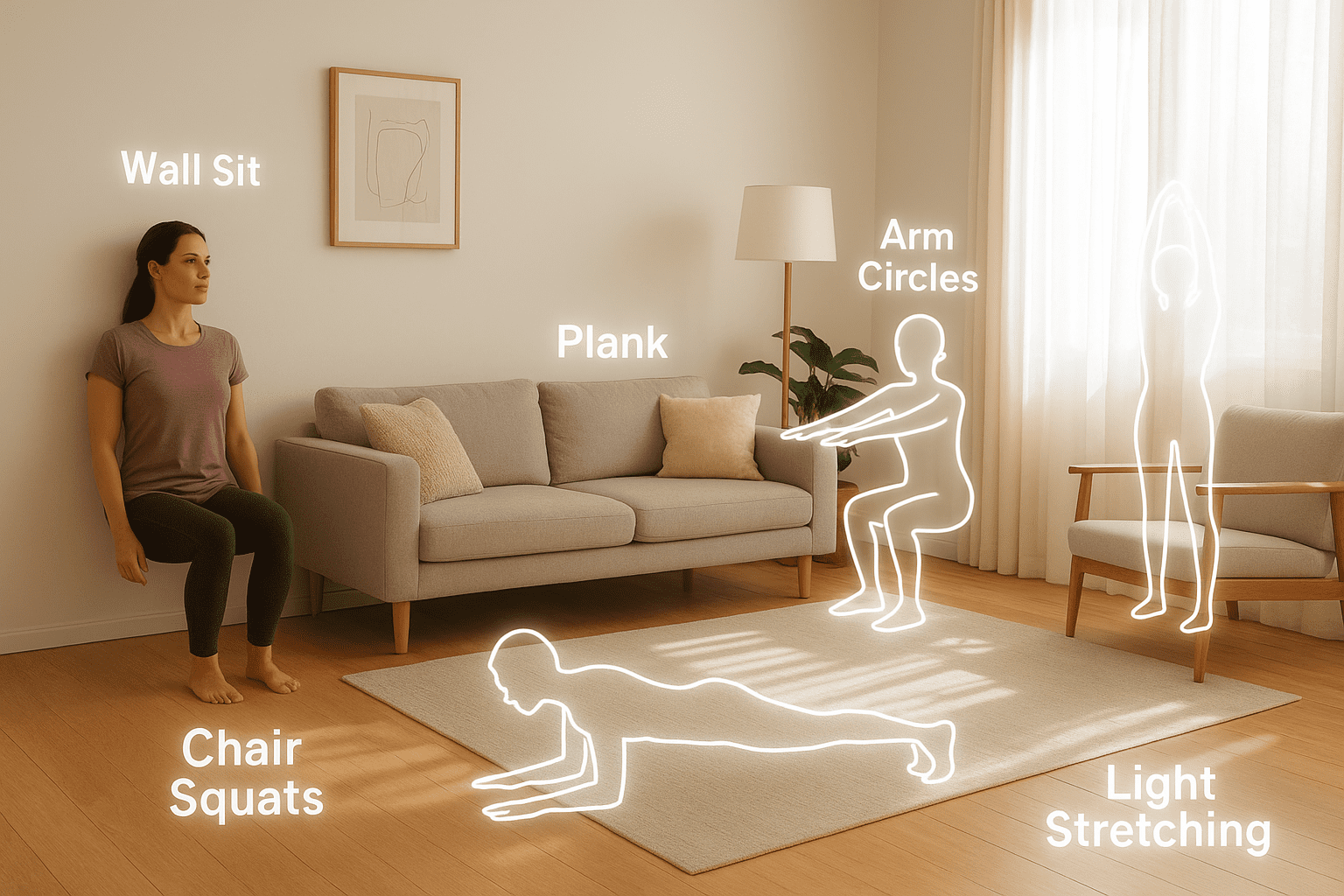
Introduction: Fitness for Your Hectic Schedule
Finding time for simple exercises for busy people has become one of the biggest challenges in modern life, where work deadlines, family commitments, and endless responsibilities leave little room for hour-long gym sessions. The good news is that you don’t need extensive time or expensive equipment to maintain fitness, build strength, and support your health—you just need the right exercises that deliver maximum results in minimum time.
The most effective simple exercises for busy people are those that engage multiple muscle groups simultaneously, can be performed anywhere without special equipment, require only 15-20 minutes to complete, and provide both cardiovascular and strength benefits in a single session. These efficient workouts eliminate the common excuse of “not enough time” by fitting seamlessly into packed schedules—before work, during lunch breaks, or in the evening after putting kids to bed.
This comprehensive guide presents seven proven exercises that busy professionals, parents, students, and anyone with limited time can integrate into their daily routine. You’ll discover proper form and technique for each movement, time-efficient workout combinations that maximize results, how to progress from beginner to advanced levels, and realistic schedules for maintaining consistency even during your busiest weeks.
Why These Exercises Work for Busy Schedules
The Science of Time-Efficient Exercise
High-efficiency movements share key characteristics:
Compound exercises: Movements engaging multiple muscle groups simultaneously burn more calories, build functional strength, save time compared to isolated exercises, and create greater metabolic afterburn effect.
Bodyweight-based: No equipment required means no commute to gym, no setup or cleanup time, exercise anywhere (home, office, hotel, park), and zero cost beyond comfortable clothing.
Minimal time investment: 15-20 minutes provides significant health benefits, consistency easier to maintain than hour-long sessions, fits into small schedule gaps, and research shows brief, intense workouts match benefits of longer moderate sessions.
Cardiovascular and strength combined: Dual benefits from single workout session, elevated heart rate while building muscle, time-saving compared to separate cardio and strength days, and improved overall fitness efficiency.
Health Benefits of Brief, Regular Exercise
Even short exercise sessions provide:
According to the American Heart Association, accumulating just 150 minutes of moderate activity weekly (about 20 minutes daily) significantly reduces cardiovascular disease risk, improves mental health, supports weight management, and increases longevity.
Research published in the British Journal of Sports Medicine found that even 15 minutes of daily exercise reduced all-cause mortality by 22% compared to no exercise—proving that some movement is infinitely better than none, regardless of how busy you are.
Official resource: https://www.heart.org/en/healthy-living/fitness/fitness-basics/aha-recs-for-physical-activity-in-adults
7 Simple Exercises for Busy People
1. Burpees: The Ultimate Full-Body Exercise
Why it’s perfect for busy people: Burpees combine cardiovascular conditioning with strength training, engage every major muscle group, require zero equipment, and burn 10+ calories per minute—one of the highest calorie-burning exercises possible.
How to perform properly:
- Starting position: Stand with feet shoulder-width apart
- Squat down: Place hands on floor in front of feet
- Jump back: Extend legs into plank position (straight body line)
- Push-up: Lower chest to ground, then push back up (optional for beginners)
- Jump forward: Bring feet back to hands
- Jump up: Explosively jump upward, reaching arms overhead
- Land and repeat: Land softly and immediately begin next rep
Modifications for different fitness levels:
- Beginner: Step back into plank instead of jumping, eliminate push-up, step forward instead of jump
- Intermediate: Standard burpee with push-up
- Advanced: Add tuck jump at top, increase speed, wear weighted vest
Time-efficient workout:
- 5 rounds of 10 burpees with 30-60 seconds rest between rounds
- Total time: 10-15 minutes
- Calories burned: 100-150 depending on intensity
Real-world application: A 35-year-old executive travels frequently for work. She performs 5 sets of 8 burpees in her hotel room each morning (8 minutes total), maintaining fitness despite unpredictable schedule and no gym access.
✅ Pros
- Maximum calorie burn in minimal time
- Works entire body comprehensively
- Can be done anywhere, anytime
- Builds both strength and endurance
❌ Cons
- High intensity may be challenging initially
- Impact stress on joints (can be modified)
- Requires space to jump
- Can be loud in apartments
Expert tip: Focus on form over speed—poor technique increases injury risk and reduces effectiveness. Master each component before attempting full-speed burpees.
2. Squats: Lower Body Strength Foundation
Why squats are essential: This fundamental movement strengthens legs and glutes (largest muscle groups, highest calorie burn), supports functional movement patterns used daily, improves posture and core stability, and requires no equipment for effective workout.
Proper squat technique:
- Stance: Feet shoulder-width apart, toes slightly outward
- Initiation: Push hips back as if sitting in chair
- Descent: Lower until thighs parallel to ground (or deeper if mobility allows)
- Knee tracking: Knees track over toes, don’t collapse inward
- Chest up: Maintain upright torso, eyes forward
- Ascent: Drive through heels, squeeze glutes at top
- Breathing: Inhale down, exhale up
Variations to prevent boredom:
- Bodyweight squats: Foundation for beginners
- Jump squats: Add explosive power and cardio
- Sumo squats: Wider stance targets inner thighs
- Single-leg squats: Advanced balance and strength challenge
- Pulse squats: Small movements at bottom for intensity
Quick squat workout:
- 4 sets of 20 bodyweight squats
- Rest 30 seconds between sets
- Total time: 8-10 minutes
- Add jump squats in final set for intensity
Success story: A 42-year-old father with demanding job and three kids performs 100 bodyweight squats daily (broken into 5 sets of 20 throughout the day—morning, lunch, afternoon, evening, before bed). After 3 months, he’s stronger, has more energy for activities with children, and maintains leg strength without gym membership.
✅ Pros
- Strengthens largest muscle groups
- Improves everyday functional movement
- Easy to learn proper form
- Countless variations available
❌ Cons
- Knee issues require modifications
- Proper form critical to prevent injury
- May need guidance initially
- Mobility limitations affect depth
Source: https://www.mayoclinic.org/healthy-lifestyle/fitness/multimedia/squat/vid-20084632
3. Push-Ups: Upper Body and Core Strength
The push-up advantage: This classic exercise builds chest, shoulders, triceps, and core simultaneously, requires only floor space, easily modified for all fitness levels, and provides measurable progress tracking.
Perfect push-up form:
- Hand placement: Slightly wider than shoulder-width
- Body alignment: Straight line from head to heels
- Core engaged: Squeeze abs and glutes throughout
- Descent: Lower until chest nearly touches ground
- Elbows: 45-degree angle from body (not flared out)
- Ascent: Push back up explosively
- Breathing: Inhale down, exhale up forcefully
Progressive difficulty levels:
- Wall push-ups: Easiest, perfect for absolute beginners
- Incline push-ups: Hands on bench/chair, reduces difficulty
- Standard push-ups: Full plank position on ground
- Decline push-ups: Feet elevated, increases difficulty
- One-arm push-ups: Advanced strength demonstration
Efficient push-up protocol:
- Perform maximum reps with good form
- Rest 60 seconds
- Repeat for 3-5 sets
- Total time: 8-12 minutes
- Track reps to measure progress weekly
Real application: A 38-year-old remote worker sets timer for hourly push-up breaks. Each hour, she drops and performs 10-15 push-ups (1 minute). By day’s end, she’s completed 80-120 push-ups while breaking up sedentary work—maintaining upper body strength without dedicated workout time.
✅ Pros
- Works multiple upper body muscles
- Highly adaptable to fitness level
- Requires no equipment
- Progress easily measurable
❌ Cons
- Wrist discomfort for some people
- Requires upper body strength baseline
- Form breaks down when fatigued
- Can be monotonous without variation
Expert advice: If standard push-ups are too difficult, start with incline push-ups on kitchen counter or sturdy table. As strength builds, progressively lower hand position until you reach floor level.
4. Planks: Core Stability and Strength
Why planks are invaluable: This isometric exercise builds deep core strength essential for all movement, improves posture and reduces back pain, requires minimal space and zero equipment, and provides foundation for advanced exercises.
Proper plank position:
- Forearm placement: Elbows directly under shoulders
- Body alignment: Straight line from head to heels
- Core braced: Squeeze abs as if preparing for punch
- Glutes engaged: Squeeze to prevent lower back sag
- Neutral spine: Don’t let hips drop or pike up
- Breathing: Steady, controlled breaths throughout
- Head position: Neutral, looking at floor slightly ahead
Plank variations for comprehensive core:
- Standard plank: Foundation position, hold 30-60 seconds
- Side plank: Targets obliques, balances core development
- Plank with shoulder taps: Adds dynamic stability challenge
- Plank jacks: Jumping feet in/out for cardio element
- Walking plank: Alternate between forearms and hands
Quick core workout:
- Standard plank: 45 seconds
- Rest: 15 seconds
- Side plank right: 30 seconds
- Side plank left: 30 seconds
- Rest: 15 seconds
- Plank with shoulder taps: 30 seconds
- Total time: 3-4 minutes
Practical example: A 45-year-old with chronic lower back pain from desk work started daily 2-minute plank routine (3 sets of 40 seconds). After 6 weeks of consistency, back pain decreased significantly, posture improved, and core felt noticeably stronger during daily activities.
✅ Pros
- Exceptionally effective for core strength
- Low impact, safe for most people
- Measurable progress (increasing hold time)
- Improves posture significantly
❌ Cons
- Can be boring (static hold)
- Shoulder discomfort possible
- Form breaks down when fatigued
- Requires body awareness to maintain alignment
Important: If lower back sags during plank, either drop to knees or reduce hold time—poor form creates injury risk and doesn’t build proper core strength.
5. Lunges: Functional Leg Strength and Balance
The lunge benefit: This unilateral exercise corrects muscle imbalances between legs, improves balance and coordination, mimics natural movement patterns (walking, climbing stairs), and requires no equipment while building serious leg strength.
Proper lunge technique:
- Starting stance: Stand tall, feet hip-width apart
- Step forward: Take comfortable stride forward
- Descent: Lower back knee toward ground
- Front knee: Should be directly over ankle (not past toes)
- Torso: Keep upright, don’t lean forward
- Depth: Both knees at approximately 90 degrees
- Return: Push through front heel to starting position
Lunge variations:
- Forward lunges: Standard version, alternating legs
- Reverse lunges: Step backward, easier on knees
- Walking lunges: Move forward with each step (requires space)
- Jumping lunges: Explosive switch for cardio
- Lateral lunges: Side-to-side for inner/outer thigh
Time-efficient lunge workout:
- 3 sets of 10 lunges per leg (20 total per set)
- Rest 30-45 seconds between sets
- Total time: 8-10 minutes
- Combine with squats for complete lower body
Real-world success: A 50-year-old noticed difficulty with stairs and balance. She started performing 10 reverse lunges per leg daily (2 minutes total). After 2 months, stair climbing became easier, balance improved dramatically, and leg strength returned to levels from a decade earlier.
✅ Pros
- Corrects left-right strength imbalances
- Excellent for functional fitness
- Improves balance significantly
- Many variations prevent boredom
❌ Cons
- Balance challenges for beginners
- Knee issues may limit range
- Requires more space than some exercises
- Coordination takes practice
6. Mountain Climbers: Cardio and Core Combined
Why mountain climbers are efficient: This dynamic movement elevates heart rate quickly for cardio benefits, engages core throughout movement, works shoulders and arms, and burns high calories in short time.
Proper mountain climber form:
- Start position: High plank (hands under shoulders)
- Core tight: Maintain plank throughout entire movement
- Knee drive: Bring one knee toward chest
- Return: Extend leg back to plank position
- Alternate: Switch legs in running motion
- Speed: Controlled initially, faster as fitness improves
- Breathing: Rhythmic throughout movement
Mountain climber variations:
- Slow controlled: Focus on form, easier for beginners
- Fast pace: Cardio emphasis, higher calorie burn
- Cross-body: Bring knee to opposite elbow (oblique work)
- Elevated: Hands on bench reduces difficulty
- Spider climbers: Knee comes to outside of elbow
Quick cardio blast:
- 30 seconds mountain climbers
- 30 seconds rest
- Repeat for 5-8 rounds
- Total time: 5-8 minutes
- Excellent pre-work energizer
Application example: A 32-year-old busy parent wakes 10 minutes before kids for quick workout: 1 minute jumping jacks (warm-up), 5 rounds of 40-second mountain climbers with 20-second rest, 2-minute plank cooldown. Total time: 9 minutes. This brief morning routine maintained fitness through demanding parenting phase when longer workouts impossible.
✅ Pros
- Combines cardio and strength
- High calorie burn per minute
- Full-body engagement
- Energizing and mood-boosting
❌ Cons
- High impact on wrists
- Requires coordination
- Noise may disturb others
- Intense for complete beginners
Modification tip: If wrists hurt, perform mountain climbers with hands on sturdy chair or bench—reduces wrist angle and decreases difficulty while building strength.
7. Jumping Jacks: Classic Cardio Warm-Up
The jumping jack value: This simple movement elevates heart rate quickly, warms up entire body, improves coordination, and serves as perfect warm-up or standalone cardio.
Correct jumping jack form:
- Starting position: Stand tall, feet together, arms at sides
- Jump: Spread feet wider than shoulder-width
- Arms: Raise overhead in arc
- Land: Soft landing on balls of feet
- Return jump: Bring feet together, arms to sides
- Rhythm: Smooth, continuous motion
- Breathing: Natural rhythm, don’t hold breath
Jumping jack alternatives:
- Low-impact jacks: Step side to side instead of jumping
- Seal jacks: Arms come forward instead of overhead
- Squat jacks: Add squat when feet spread
- Star jumps: More explosive jump with fuller extension
Effective cardio protocol:
- 1 minute jumping jacks
- 1 minute rest (or active recovery like marching in place)
- Repeat 5-10 rounds
- Total time: 10-20 minutes
- Adjust rounds to available time
Realistic implementation: A 40-year-old works from home with sedentary job. Every 90 minutes, she performs 50 jumping jacks (under 2 minutes). This breaks up sitting time, maintains cardiovascular health, and by day’s end accumulates 15+ minutes of cardio without dedicated workout session.
✅ Pros
- Extremely simple to perform
- Requires minimal space
- Excellent warm-up for other exercises
- Nostalgic and enjoyable for many
❌ Cons
- Can be loud in apartments
- Joint impact with high volume
- May seem too simple for some
- Limited strength-building benefit
Creating Your Busy Person Workout Routine
The 15-Minute Full-Body Circuit
Maximum efficiency workout combining all exercises:
Warm-up (2 minutes):
- 1 minute jumping jacks
- 1 minute dynamic stretching
Main circuit (repeat 2-3 times, 10-12 minutes):
- 10 burpees (60 seconds)
- 20 squats (45 seconds)
- 10 push-ups (45 seconds)
- 30-second plank (30 seconds)
- 10 lunges per leg (60 seconds)
- 30 seconds mountain climbers (30 seconds)
- Rest 60 seconds between rounds
Cool-down (1-2 minutes):
- Light stretching
- Controlled breathing
Total time: 15-17 minutes
Frequency: 3-5 times weekly
Results: Improved strength, endurance, body composition with minimal time investment
Workout Variations for Different Schedules
Ultra-busy days (5-10 minutes):
- Choose 2-3 exercises
- Perform 3 rounds with minimal rest
- Example: Burpees, squats, planks
Moderate time available (20 minutes):
- Full 7-exercise circuit
- 3-4 rounds
- Include proper warm-up and cool-down
Morning energizer:
- Jumping jacks, burpees, mountain climbers
- High energy, cardio-focused
- Wakes up body and mind
Lunch break workout:
- Squats, lunges, push-ups, planks
- Lower intensity, less sweating
- Can be done in business casual
Evening stress relief:
- All 7 exercises at moderate pace
- Focus on form and breathing
- Mental decompression
Progression and Tracking Progress
How to Increase Difficulty Over Time
Progressive overload principles:
Increase repetitions: Start with 10 reps, progress to 15, then 20 as strength builds.
Reduce rest periods: Begin with 60-second rest, gradually decrease to 30 seconds between sets.
Add rounds: Start with 2 circuit rounds, progress to 3, then 4 as endurance improves.
Advance variations: Move from beginner modifications to standard forms to advanced variations.
Increase tempo: Perform movements faster (with controlled form) to elevate heart rate and intensity.
Combine exercises: Create compound movements like burpee-push-up-jump or squat-to-lunge flows.
Measuring Your Fitness Improvements
Track these metrics weekly:
- Repetitions: How many of each exercise can you complete?
- Total workout time: Can you finish circuit faster while maintaining form?
- Rest needed: Are rest periods decreasing naturally?
- Form quality: Is proper technique maintained throughout?
- How you feel: Energy levels, sleep quality, mood improvements
- Body changes: Measurements, how clothes fit, photos
Realistic expectations:
Week 1-2: Learning proper form, initial soreness, establishing routine
Week 3-4: Noticeable strength gains, movements feel smoother, recovery faster
Month 2-3: Visible body composition changes, significantly increased repetitions, workouts feel easier
Month 4+: Substantial fitness improvements, strong habits established, ready for advanced variations
Common Mistakes and How to Avoid Them
Form Over Speed
The most critical principle: Perfect form with slower tempo always beats sloppy fast repetitions. Poor form increases injury risk, reduces exercise effectiveness, creates bad movement patterns, and wastes the limited time you have.
Form checklist for each exercise:
- Video yourself periodically to check technique
- Prioritize full range of motion
- Move with control (both up and down phases)
- Maintain core engagement throughout
- Stop set when form breaks down
The Consistency Trap
Common mistake: Exercising intensely for 2 weeks, then quitting when schedule gets busy.
Solution: Three 15-minute sessions weekly for a year produces dramatically better results than daily hour-long workouts for one month followed by nothing. Consistency always beats intensity for long-term fitness.
Sustainable approach:
- Schedule workouts like important meetings
- Start with realistic frequency (3x weekly)
- Have backup “minimum viable workout” for crazy days (5 minutes better than zero)
- Don’t aim for perfection—aim for consistency
Neglecting Warm-Up and Recovery
Even short workouts require preparation:
Warm-up (2-3 minutes): Light cardio (jumping jacks, jogging in place) and dynamic stretching (arm circles, leg swings) prevent injuries and improve performance.
Cool-down (2-3 minutes): Gradual heart rate reduction, light stretching, controlled breathing supports recovery and reduces soreness.
Rest days: Muscles grow during rest, not during workouts. Even busy people need 1-2 rest days weekly for optimal results.
Making Exercise a Sustainable Habit
Overcoming the “Too Busy” Mindset
Truth: You’re not too busy to exercise—you haven’t prioritized it yet. We make time for what matters. If you can scroll social media for 15 minutes, you can exercise for 15 minutes.
Mindset shifts:
- Exercise is self-care, not selfish—you’re better parent/employee/partner when healthy
- 15 minutes is 1% of your day—you have 1% for your health
- You’re never “too busy” to eat or sleep—treat movement similarly
- Future you will thank present you for prioritizing fitness
Environmental Design for Success
Make exercise the path of least resistance:
Remove barriers:
- Keep workout clothes where you’ll see them
- Exercise first thing (before decision fatigue sets in)
- Have backup plan for bad weather (indoor workout ready)
Create triggers:
- “After morning coffee, I do 5-minute workout”
- “During kids’ TV time, I exercise”
- “Before shower, I complete circuit”
Track and celebrate:
- Calendar X for each workout day
- Celebrate streaks (10 days, 30 days, 100 days)
- Share progress with accountability partner
Conclusion: Your Simple Exercise Action Plan
These 7 simple exercises for busy people—burpees, squats, push-ups, planks, lunges, mountain climbers, and jumping jacks—provide everything you need for comprehensive fitness without gym memberships, expensive equipment, or extensive time commitments. When performed consistently just 15-20 minutes three to five times weekly, these movements build strength, improve cardiovascular health, support weight management, and enhance overall quality of life.
Essential principles to remember:
Consistency matters infinitely more than perfection—three brief workouts weekly for months produce better results than intense daily sessions for two weeks followed by burnout. Proper form protects against injury and maximizes effectiveness, making quality repetitions more valuable than rushing through high quantities. Start where you are, not where you think you “should” be—beginners should master modifications before progressing to advanced variations.
The most important workout is the one you’ll actually do. Choose exercises you don’t hate, schedule workouts when you’re most likely to follow through, and remember that even 10 minutes of movement dramatically outperforms zero minutes of planning the “perfect” routine you never execute.
Your fitness journey doesn’t require perfect circumstances, unlimited time, or ideal motivation—it requires 15 minutes and the decision to start today rather than waiting for the “right time” that never comes.
Your action plan:
- Today: Perform one set of each exercise to learn proper form (10 minutes)
- This week: Complete three 15-minute workouts using the circuit provided
- This month: Establish consistent 3-5 workouts weekly schedule
- Track progress: Note repetitions weekly to see improvements
- Adjust as needed: Modify exercises to match your current fitness level
Busy schedules don’t prevent fitness—they require smarter exercise choices. These seven simple movements provide that smart solution, delivering maximum results in minimum time so you can maintain health and strength regardless of how hectic life becomes.
If you believe in spreading education and helping others grow, you can support my mission here:
Support Education, Empower Lives
Ready to reclaim your fitness? Set a 15-minute timer right now, warm up with 1 minute of jumping jacks, then perform as many quality reps as possible of squats, push-ups, and planks. That’s your workout—done. Repeat this same simple routine three times this week and you’ve officially started your journey to sustainable fitness despite your busy schedule.
Share your thoughts in the comments and don’t forget to share this article with your friends:Your learning doesn’t stop here.
Keep exploring and growing with:
- AI Apps for Android & iOS
- AI Chatbots & Automation
- Ai for YouTube / Creators
- Ai Tools & Productivity
- AI Voice & Music Tools
- AI Writing Tools
- Health & Fitness
- iPhone 17 Series
- Web Hosting
- Windows 11 Update
Frequently Asked Questions:
Do I need any equipment for these exercises?
These seven exercises require zero equipment and can be performed effectively with just your bodyweight, though a few optional items enhance comfort and expand variations without being necessary for results. Absolutely required: Nothing—your body provides all resistance needed for effective workouts. Comfortable clothing that allows free movement and athletic shoes with cushioning for jumping exercises. Highly recommended but not required: Exercise mat or towel for floor exercises (planks, push-ups) protects hands and knees on hard surfaces, though carpet works fine. Timer or smartphone with timer app to track work and rest intervals keeps workouts structured. Optional equipment that expands possibilities: Resistance bands add variable resistance to squats and lunges for advanced progression. Pull-up bar (doorway-mounted) enables additional upper body exercises beyond push-ups. Dumbbells or household alternatives (water bottles, books) increase load for weighted variations once bodyweight becomes easy. Chair or sturdy bench allows incline/decline variations for push-ups and step-ups for variety. Household alternatives work excellently: Wall serves for wall push-ups and wall sits. Stairs provide incline for push-ups and platform for step-ups. Kitchen counter offers stable surface for elevated exercises. Filled backpack adds weight for weighted squats or lunges without buying equipment. The beauty of these exercises is their accessibility—you can achieve excellent fitness results with nothing more than floor space and your body, making them perfect for travel, home workouts, or exercising anywhere without gym access.
What if I can’t do these exercises due to injury or limitation?
Every exercise in this guide can be modified to accommodate injuries, limitations, or different fitness levels, and alternatives exist for virtually any restriction. For joint issues (knees, wrists, shoulders): replace high-impact moves (burpees, jumping jacks) with low-impact alternatives (step-backs, marching in place), perform exercises on cushioned surface or mat, try incline versions to reduce joint angle stress (incline push-ups easier on wrists), and consult physical therapist for specific modifications. For balance concerns: hold wall or sturdy chair during lunges and squats, start with static exercises (planks) before dynamic moves, practice near support until confidence builds, and consider seated exercise variations initially. For cardiovascular limitations: reduce intensity and extend rest periods, focus on strength movements (planks, static holds) instead of cardio-intensive exercises, monitor heart rate and stay in comfortable zone, and gradually progress as cardiovascular capacity improves. For significant injuries or health conditions: absolutely consult healthcare provider or physical therapist before starting any exercise program, as they can provide personalized modifications, potentially recommend therapeutic exercises that support recovery, and ensure you’re progressing safely. The fundamental principle is that some movement is always better than no movement—even if you can only perform modified versions or need to avoid certain exercises entirely, working within your capabilities builds fitness safely and sustainably.
How many times per week should busy people exercise?
The optimal exercise frequency for busy people is 3-5 times weekly, with three sessions representing the minimum for maintaining fitness and five sessions providing accelerated improvements without overtraining risks. Research shows that exercising fewer than three times weekly produces minimal physiological adaptations, while more than five weekly sessions often leads to burnout, injury, or schedule conflicts for people with demanding lives. The ideal weekly schedule balances consistency with recovery: 3 sessions weekly (Monday, Wednesday, Friday) provides adequate rest between workouts, maintains strength and cardiovascular health, fits realistically into busy schedules, and serves as sustainable long-term minimum. 4 sessions weekly (Monday, Tuesday, Thursday, Friday) accelerates results compared to three sessions, allows working around one busy day per week, still provides adequate recovery, and represents optimal balance for most busy people. 5 sessions weekly (Monday through Friday, weekends off) maximizes results without overtraining, utilizes workday routine consistency, preserves weekends for family/rest, but requires strong habit formation to maintain. More important than perfect frequency is consistency—three workouts every single week for a year produces far better results than five workouts weekly for one month followed by nothing. Start with three sessions weekly and add more only if you maintain perfect consistency for 4-6 weeks, as attempting too much too soon leads to the burnout that sabotages long-term fitness.
Can I really get fit with just 15-20 minutes of exercise?
Yes, brief, intense workouts can produce significant fitness improvements when performed consistently, though expectations should be realistic about what 15-20 minutes can achieve compared to longer training sessions. Research published in PLOS ONE found that participants performing 10-minute high-intensity workouts three times weekly improved cardiovascular fitness, strength, and body composition comparably to those doing traditional 45-minute moderate workouts. The key factors making short workouts effective include: compound movements engaging multiple muscle groups simultaneously maximize calorie burn and strength gains in limited time; higher intensity creates metabolic effects lasting hours after brief sessions (EPOC or “afterburn” effect); consistency matters more than duration—three 15-minute sessions weekly for six months dramatically outperforms sporadic hour-long workouts; and progressive overload ensures continued adaptation. However, realistic expectations matter: 15-20 minutes will maintain fitness and create moderate improvements, but won’t produce elite athletic performance or bodybuilder physiques. For general health, weight management, functional strength, and cardiovascular fitness, brief consistent workouts absolutely work. The American Heart Association confirms that accumulating 150 minutes weekly (achievable with 20-minute sessions) provides substantial health benefits including reduced disease risk and improved longevity.